
The Nile Crocodile: Africa’s Master Predator & Guardian of the Waters
Explore the world of the Nile crocodile with Miana Tours & Travel – from its prehistoric power to its vital role in Uganda’s river ecosystems.
The African wilderness holds countless extraordinary creatures, yet few inspire the mix of awe, respect, and fascination quite like the Nile crocodile. With a lineage stretching back millions of years, this powerful reptile has earned its place as one of the continent’s most skilled predators and one of nature’s most resilient survivors. Found throughout Uganda’s great waterways – especially along the River Nile, Murchison Falls National Park, and Queen Elizabeth National Park – the Nile crocodile remains a thrilling highlight on every wildlife or boat safari.
At Miana Tours & Travel, we take pride in guiding guests through Uganda’s breathtaking landscapes, where these reptiles are often seen basking on riverbanks or gliding silently beneath the surface. This comprehensive guide uncovers everything you need to know about Nile crocodiles: where they live, how they hunt, their social behaviors, cultural significance, and why conserving them is crucial for Africa’s ecosystems.
Habitat & Distribution of the Nile Crocodile
The Nile crocodile’s adaptability is one of its greatest strengths. These reptiles thrive in a range of freshwater environments – lakes, rivers, swamps, and marshlands. In Uganda, they are especially visible along the Nile River, within Murchison Falls National Park, Queen Elizabeth National Park, the Kazinga Channel, and parts of Lake Albert.
Their ability to survive in varied water conditions, including brackish and seasonal floodplains, has allowed them to spread across much of sub-Saharan Africa. Their preferred habitats provide abundant food, basking sites, and sheltered nesting areas essential for their survival.
Physical Characteristics: Built for Power & Survival
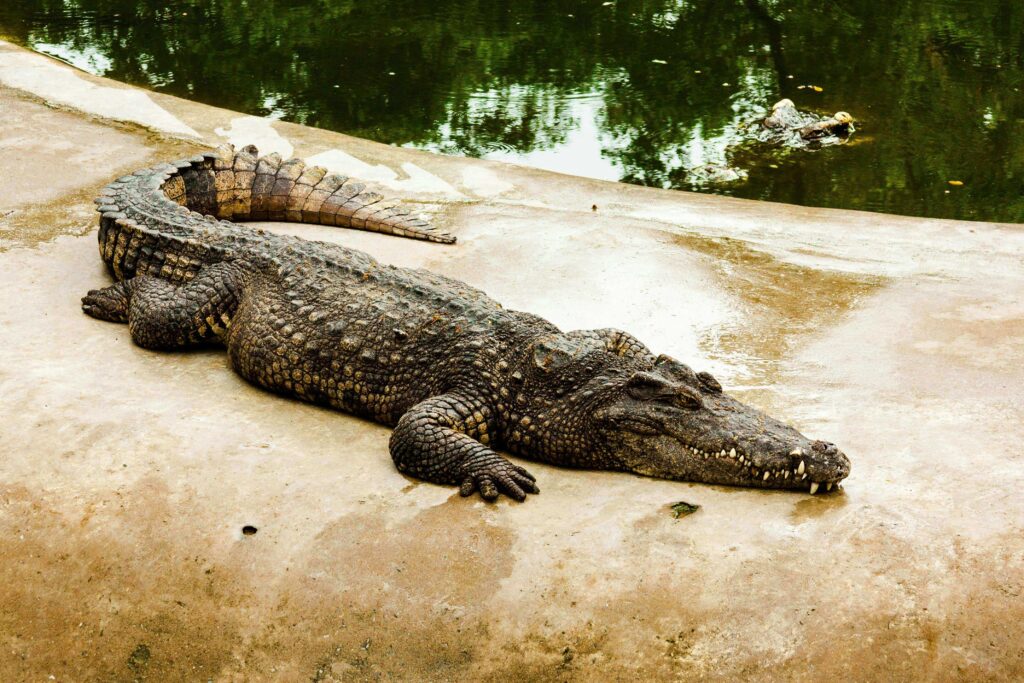
The Nile crocodile’s body is a masterpiece of evolution. Covered in rugged scales reinforced by osteoderms, its armor-like skin offers exceptional protection and helps regulate body temperature. Their powerful tails propel them forward with surprising speed, allowing them to strike prey with explosive force.
Their sensory system is equally remarkable. They see exceptionally well in low light, making dawn and dusk prime hunting periods. The nictitating membrane – a transparent eyelid – allows them to see underwater while protecting their eyes. Their hearing and sense of vibration detection are so advanced that they can sense movement from long distances.
Diet & Hunting Techniques: Africa’s Silent Ambusher
Nile crocodiles have a varied diet that evolves with age. Juveniles feed on insects, small fish, and amphibians. As they grow, their menu expands to include larger fish, waterbirds, antelopes, monkeys, and occasionally livestock in areas near human settlements.
Their hunting style is one of patience and precision. Remaining almost completely submerged, they wait for prey to approach the water. With incredible speed, they lunge upward, seizing the target with their powerful jaws before dragging it into deeper water.
Nile crocodiles also display surprising intelligence. In rare instances, they cooperate during hunts, particularly when herding schools of fish into shallow waters where catching them becomes easier.
Reproduction & Life Cycle: A Fiercely Protective Mother
Breeding season for Nile crocodiles begins during the dry months. Males engage in dramatic displays involving deep bellows, splashing, and aggressive posturing to attract mates. Once paired, females dig nests in elevated sandy riverbanks, laying between 25 and 80 eggs.
For the next 90 days, the mother guards her nest, protecting it from predators like monitor lizards and birds. When hatchlings emerge, they chirp loudly from inside the eggs – a signal for the mother to help excavate the nest and deliver them safely to the water.
Though many fall prey to predators, the survivors grow gradually, reaching maturity around 10-12 years and potentially living up to 70-100 years in the wild.
Social Behavior & Territoriality
While often viewed as solitary, Nile crocodiles frequently gather in groups to bask, feed, or share limited water sources. A clear hierarchy exists – the largest and strongest dominate prime basking spots and food access.
Surprisingly, they may tolerate one another when conditions require cooperation, particularly during fish migrations or droughts when water sources shrink.
Cultural Significance Across Africa
The Nile crocodile has long been revered in African culture. In ancient Egypt, the crocodile deity Sobek symbolized strength, fertility, and protection. Temples dedicated to Sobek illustrated both fear and admiration for this mighty reptile, reflecting its deep connection with the Nile’s life-giving waters.
Fascinating Facts About Nile Crocodiles
- They have the strongest bite force of any living animal – over 5,000 psi.
- Crocodiles can slow their metabolism and survive months without food.
- They communicate using grunts, vibrations, and water slaps.
- They are among the world’s oldest surviving reptile species.
- Young crocodiles often “play,” showing unexpected intelligence.
Conservation: Protecting a Vital Species
Nile crocodiles play a crucial ecological role by regulating fish populations and maintaining healthy river ecosystems. However, they face threats from habitat loss, illegal hunting, pollution, and conflicts with local communities.
Through responsible tourism, education, and community involvement, Miana Tours & Travel supports conservation initiatives that protect both people and wildlife. Understanding and valuing the presence of these ancient reptiles is key to ensuring their future.
Crocodile Viewing Tips
- ✔ Stay inside the boat or vehicle
- ✔ Avoid getting close to riverbanks
- ✔ Keep cameras secure
- ✔ Maintain respectful distances
- ✔ Follow your guide’s instructions
Did You Know?
Nile crocodiles can hold their breath for over an hour while resting underwater.
Related Articles
© 2025 Miana Tours & Travel. All Rights Reserved. Explore Africa Responsibly.